A porous terracotta
Ceramics promote the exchange of water and gas with the medium.
 Ceramyca
CHAPTER 05 / 23
All chaptersLearn how terracotta PODs guide the mycelium, interact with living soil and can be prepared for another season.
A CONTENT · A LIVING SOIL
The POD brings together the mycelium and its reserve. Once buried, it guides its development to the first centimetres of the ground.
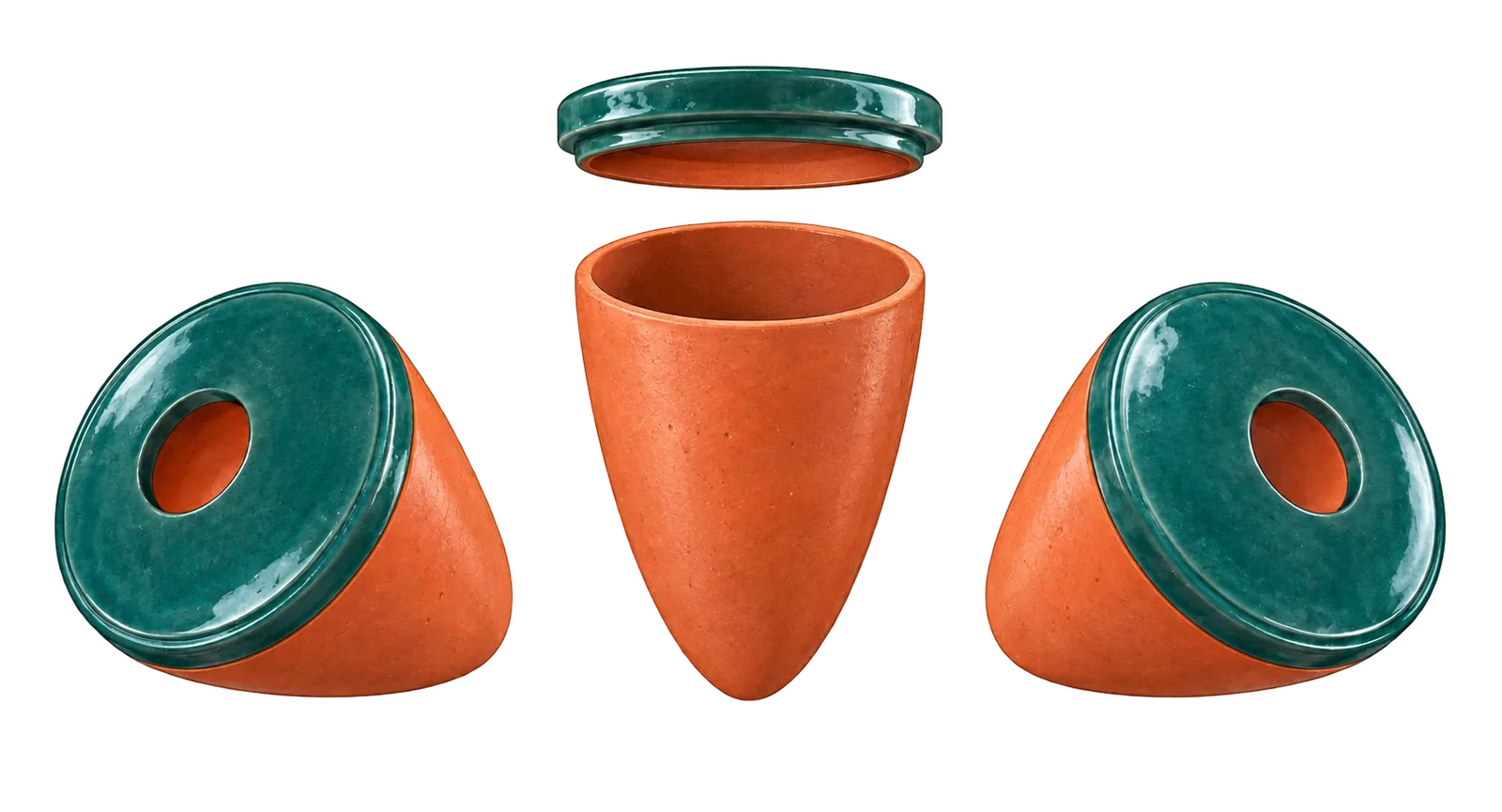
Entered into a prepared soil, the POD offers mycelium a localized starting point. Its filaments gain the ground by opening the lid; sclerotia form in the first centimetres, where fruiting is prepared.
In the POD Mycelium has a nutritional reserve.
In the ground It goes out through the lid and forms sclerotia, its reserve structures.
On the surface When conditions are met, the morels appear.
The porosity of the ceramics allows the exchange of water and gas. It forms an interface between mycelium, soil and bacterial inputs of our protocol, including Pseudomonas putida. The Ceramyca patent also refers to the proposed favourable role of iron oxide in the presence of certain bacteria.
Our microscopic observations show intercalar hyphal swelling after bacterial inoculation, absent from control cultures.
Ceramics promote the exchange of water and gas with the medium.
Bacterial inputs accompany mycelium and soil populations.
After harvest, the ceramics are removed and prepared for a new season.
The two PODs accommodate mycelium and are reused with a new recharge. Their conduct differs especially in how culture is fed.
FOR HOME GARDENERS
Its nutritional reserve is integrated: it can operate without additional nutrition bag.
To grow on a small scale, especially with kits of 3, 6 or 12 PODs.
Discover the garden PODsFOR MARKET FARMS
It is used with mycelium-linked nutrition bags after installation in the soil.
Designed to organize a plot and facilitate number plantings.
Understand nutritionFrom planting to reuse, three milestones help you follow your crop.
Moisten the soil, fill the PODs loosely and plant them in staggered rows. Cover each lid with 2 to 3 cm of soil, then level the surface.
See plantingFollow the development of mycelium and adapt water and protections. For PRO PODs, connect nutrition after 7 to 15 days, when the spreading patches reach 10 cm diameter.
Putting nutrition downAfter harvesting, remove the PODs, let their contents dry and empty. The following season starts with new mycelium.
Preparing for re-useFor Importuna, Sextelata and Eximia, sowing occurs in the fall when the temperature under tunnel drops to 18 °C. Rufobrunnea sows in early summer.
The Ower patent describes an external and removable nutrition. The work of Pion illuminates the interactions between morel and Pseudomonas putida; those of Tan study the use of nutrient bags. The Ceramyca device is described in patent EP4291014B1.
In Denmark, the Kirk brothers develop an indoor culture on a reconstituted substrate, whose key points remain secret. The terracotta visible on their photograph makes a nod to matter at the heart of Ceramyca technology.