The bacterium and the mycelium
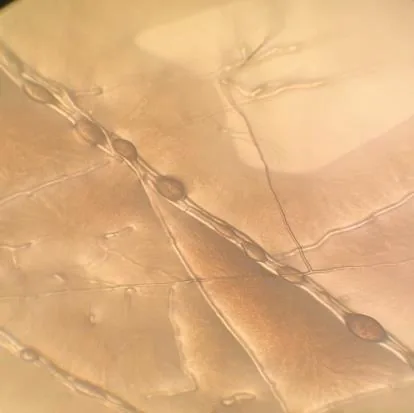
Under the microscope, the interaction with Pseudomonas putida Is accompanied by bulges on the filaments of the mycelium.
 Ceramyca
CHAPTER 12 / 23
All chaptersExplore how bacteria interact with morel mycelium, prepare the water for an application and learn what to look for in the soil.
The morel grows in a soil populated by many microorganisms. Among them, some bacteria interact with mycelium.
The Ceramyca approach consists of accompanying the culture with bacterial inputs and using the POD as an interface between the mycelium and the living medium that surrounds it.
After soil preparation and organic amendment, bring in the bacteria every year, just before sowing, during the saturation watering. The optimal time is the end of this watering.
Liquids or in powder form, the different bacterial preparations are applied one after the other. Prepare and distribute each preparation separately over the entire surface.
After application, protect the area from direct sunlight using the covers provided for your crop.
Prepare your organic amendment
Prepare your soil and, if necessary, incorporate the organic amendment provided.
Start the saturation watering. At the end of watering, prepare the first bacterium in a volume of water adapted to your equipment and distribute it evenly.
Then proceed in the same way for each other bacterial preparation. Repeat this application every year before sowing.
Respect the dose of bacterial preparation intended for the surface to be treated. There is no type of dilution: use enough water to obtain a homogeneous distribution with your equipment.
At the watering can, sprayer or through the irrigation network, adjust the volume of water and ensure that the entire surface receives the preparation. For a powdery bacteria, dilute it and homogenize it carefully before application.
When preparing the sowing, also provide, if necessary, the fight against fly larvae with Bti, under the conditions of the product used.
Over the seasons, a green cover composed of moss may appear on the plot. At Ceramyca, we follow its appearance according to the sowing method and bacterial inputs.
CERAMYCA FIELD OBSERVATIONS
A layer of green moss appears after the mycelium is buried. The moss becomes more established if cultivation continues for another year.
The appearance is later: a green cover begins to settle timidly after several years of cultivation.
Greening has not been observed at this stage of the follow-up. The contribution of Pseudomonas putida alone is sufficient under the conditions followed.
Status of monitoring at the start of the 2026–2027 season, fifth growing season with annual bacterial input. Observations carried out in the plots monitored by Ceramyca.
In the crops followed by Ceramyca, the annual contribution of Pseudomonas putida alone is enough to avoid greening with PODs. The other members of the consortium intervene, in our observations, on the yields and the taste of the morels.
Nutritious grains directly mixed into the soil remain in the plot after the season. Their transformation can change the available resources and microbial interactions over the growing seasons.
The POD keeps the initial nutrients in one place, and the container can be retrieved at the end of the season. Irrigation, light, available nutrients and soil organisms also affect the soil. To understand a layer of green moss, look at how the whole crop has been managed.
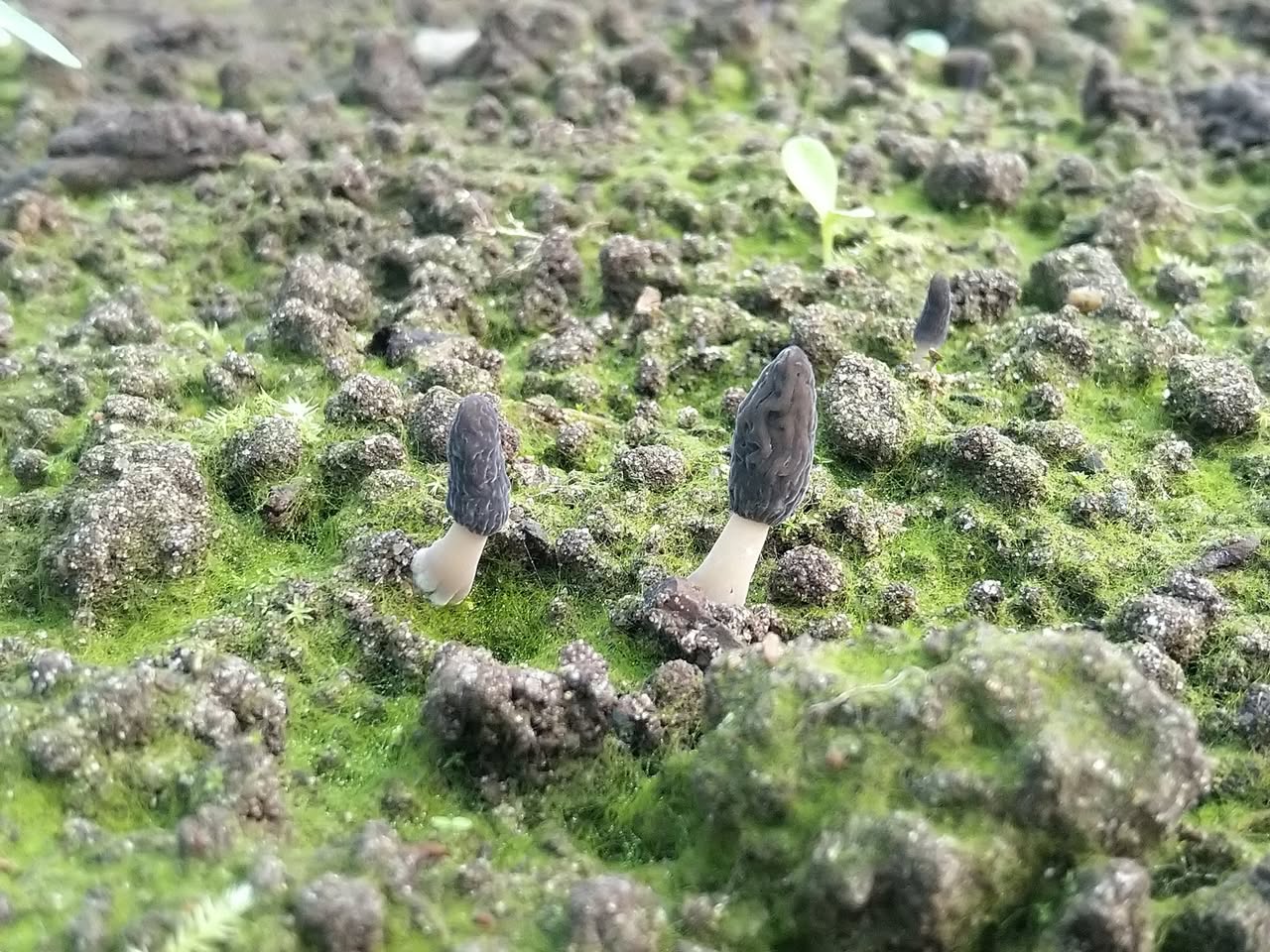
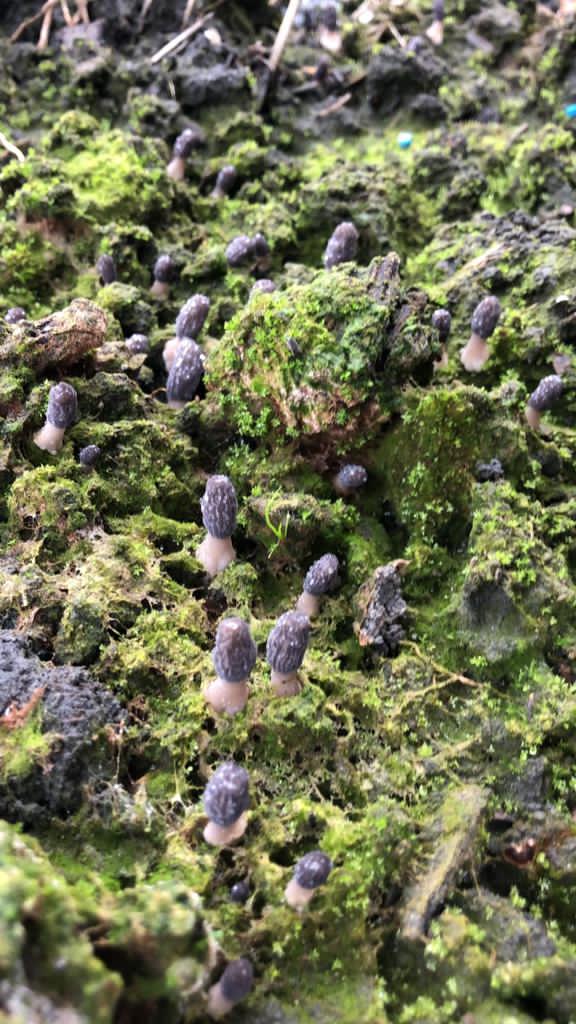
A patch of morels evolves over the seasons. Among the visible signs, a green carpet can settle between the stones, then gain ground. This cover interests us because its appearance differs depending on the mode of implantation and the bacterial inputs.
The small leafy shoots correspond to young pioneer soil mosses. The spongy material that accompanies them is probably protonema, the filamentous stage from which these shoots develop. Analysis of the cover observed in Ceramyca reveals a strong presence of cyanobacteria within the moss.
These pioneering mosses settle on bare, well-lit and regularly moist soil. With the cyanobacteria associated with them, they form a surface photosynthetic cover. Their development accompanies the evolution of the conditions of the plot and the microbial communities over the course of the crops.
The ceramic POD constitutes a porous interface between the mycelium and the soil. In the Ceramyca approach, its pores retain bacteria in contact with the mycelium filaments; the ceramic also contains iron oxide.
These partners are monitored throughout the growing cycle. Ceramyca's observations distinguish the relationship with the mycelium, the monitoring of green cover and the effects attributed to the other members of the consortium.
Under the microscope, the interaction with Pseudomonas putida Is accompanied by bulges on the filaments of the mycelium.
In the Ceramyca plots followed with PODs, an annual contribution of Pseudomonas putida Only accompanies the absence of greening observed at this stage of follow-up.
The other members of the consortium intervene, in our observations, on the yields and the taste of the morels.
These observations point towards a biological regulation of the green cover. The mechanisms envisaged concern the establishment of mosses and cyanobacteria, access to nutrient resources and interactions between organisms on the surface of the soil.
In Zou and his colleagues' experiment on Morchella sextelata, the soil receiving Pseudomonas putida contains, after 90 days, less available nitrogen, phosphorus and potassium than the control. This follow-up sheds light on the nutritional evolution of the environment. (Zou et al., 2025)
The research below sheds light on these interactions. It documents nutrient exchanges between morels and bacteria, an evolution of microbial communities during cultivation and the effects of bacterial signals on the development of a mushroom.
SCIENTIFIC REFERENCES
In a greenhouse experiment on Morchella sextelata, Pseudomonas putida KT2440 modifies the bacterial community. The peak of relative abundance of Morchella is observed at 30 days, compared to 60 in the control. The strain also uses ACC, a precursor of ethylene, as a source of nitrogen. These results shed light on the bacterial accompaniment of the mycelium and the transformation of the medium.
Zou et al. · The Effect of Pseudomonas putida on the Microbial Community in Casing Soil for the Cultivation of Morchella sextelata · Journal of Fungi, 2025.
Read the study — Zou et al., 2025 (new tab)« The fungus benefits from an additional source of carbon and increased resistance to stress of mycelium. »
In the laboratory, the mycelium of Morchella crassipes promotes the dispersion and multiplication of Pseudomonas putida, then uses carbon from the bacteria. The bacteria benefit from the exudates of the fungus and their transport along its filaments. The mycelium gains an additional source of carbon and better stress resistance: a documented example of reciprocal exchanges between porcini mushroom and bacterium.
Pion et al. · Bacterial farming by the fungus Morchella crassipes · Proceedings of the Royal Society B, 2013.
Read the study — Pion et al., 2013 (new tab)In a culture of Morchella importuna on semi-synthetic substrates, researchers observe an evolution of microbial communities. They report in particular an increase in the proportion of sequences attributed to Cyanobacteria during fruiting. The study thus shows that this phase of the cycle is part of a succession of microbial communities and an evolution of nutrient resources.
Tan et al. · Build Your Own Mushroom Soil: Microbiota Succession and Nutritional Accumulation in Semi-Synthetic Substratum Drive the Fruiting of a Soil-Saprotrophic Morel · Frontiers in Microbiology, 2021.
Read the study — Tan et al., 2021 (new tab)Bacterial communication molecules, AHLs, modify the germination of the spores of a moss. In this experiment using synthetic molecules, certain concentrations accelerate germination, while higher concentrations slow it down. The effect therefore depends on the molecules and their concentration.
Vesty et al. · Cross-kingdom signaling regulates spore germination in the moss Physcomitrella patens · Scientific Reports, 2020.
Read the study — Vesty et al., 2020 (new tab)