Effect of weather or water
Drying, cracking, slowing down.
Compare the date of signs with frost, heat, moisture and watering.
 Ceramyca
SUPPLEMENTARY READING
All chaptersRecognize crop damage, distinguish documented diseases from other causes and respond without spreading the affected area.
OBSERVER · CONTINUER · IDENTIFIER
An injured morel, a sail that extends or a foot that blows does not ask for the same answer. The first step is to bring the symptom closer to its evolution, present organisms and growing conditions.
Start with the observable facts: the tissue reached, the rate of evolution, the distribution of signs and the recent conditions of the plot. Several causes may overlap.
Drying, cracking, slowing down.
Compare the date of signs with frost, heat, moisture and watering.
Morsures, galleries, perforations.
Find the animal or its traces on the shoot and around the fireplace.
Sail that progresses, scalable stains, rotting tissues.
Document the focus, limit handling and prepare an identification.
The hygrometer gives the atmosphere around the morels. In the Ceramyca route, follow-up is done 10 cm above the ground, in the shade, with the markers of the growth chapter.
Review measuresThe congestion is in the earth and the water is removed. An 85% air moisture level does not indicate that the soil is saturated: both observations follow separately.
Observe the soil's water stateThis atlas gathers photographs of the Ceramyca guide. Open a family of symptoms, then bring the signs closer to the observations made in your culture.
Bring the lesions of recent heat, dry air or frost episodes closer together with the measurements taken under the cover.
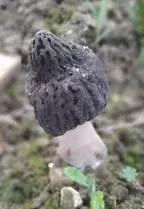
A dry head after a hot and dry episode.
To be checked: the temperature and humidity of the air, with the water condition of the bed.
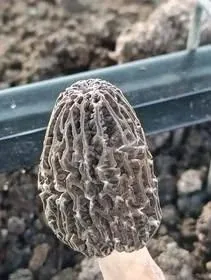
Cracks to be compared with an episode of gel.
To be checked: minimum temperatures and chronology of appearance of marks.
Observe the form of damage and search for pests on site before choosing an intervention.
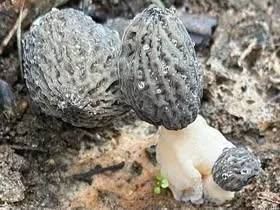
Head perforations compatible with damage of fungus gnats.
To be checked: the presence of sciarides and the distribution of perforations in the plot.
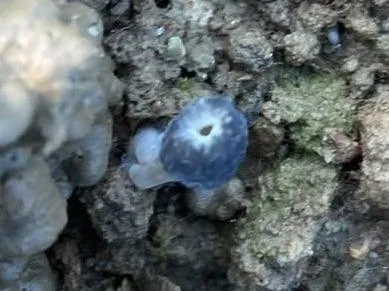
Bites on a young morel.
To be checked: the presence of slugs and bite marks on other shoots.
Cross these observations with soil conditions, water intakes and tissue evolution.
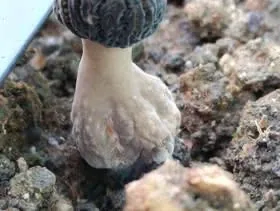
A deformed foot, to be examined with soil conditions.
To be checked: pH, possible inhibitors and deformation distribution.
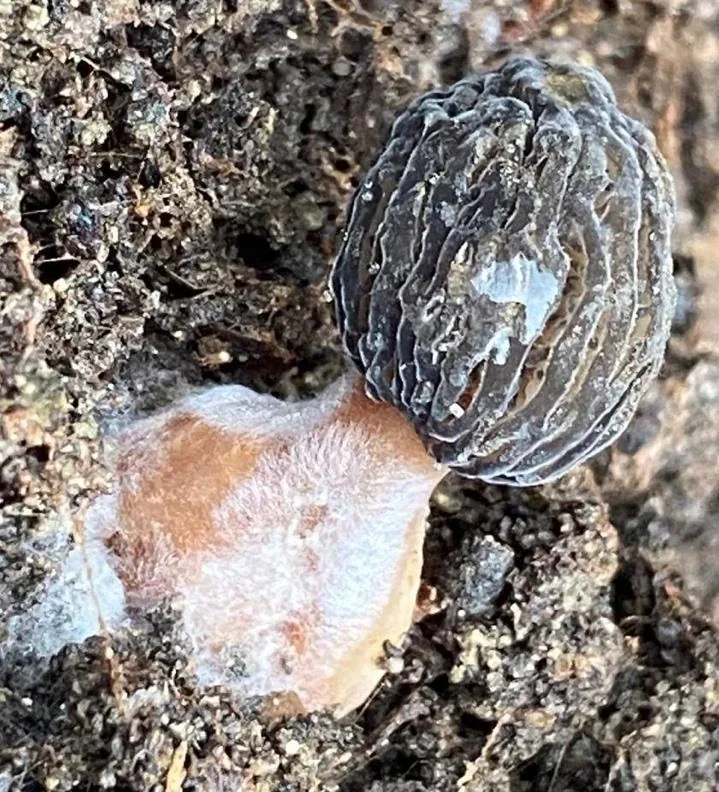
A redness accompanied by microbial development.
To be checked: a possible excess water and the progression of alteration.
Several attacks may coexist on the same morel. Examine together the head, foot and condition of the already altered tissues.
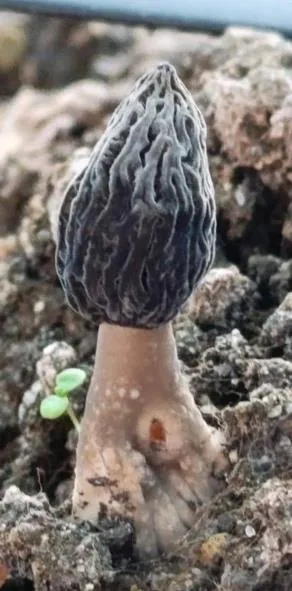
Simultaneous injuries to the head and foot.
Inspect the head and foot separately, look for the organisms present and document the affected tissues for identification.
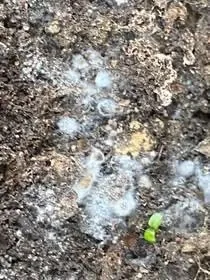
Cotton veil on an altered morel.
To be checked: the water state of the bed, the previous alterations and the progression of fungal development.
Scientific work describes several diseases and different agents. The examples below give guidelines for understanding analysis reports and publications; they are not an exhaustive list.
Former name: Diploöspora longispora
This agent is associated with the rotting of the hat. A survey of morels lesions taken from 32 Chinese growing sites showed a strong evidence. Its place in these samples does not constitute a ranking of diseases in France. [1][2]
On the ground: document the alteration of the cap and its extension; precise identification associates the examination of the sample with analyses.
Former name: Paecilomyces penicillatus
White mold agent described on morels. The phylogenetic revision published in 2023 places it in a new genus, distinct from Paecilomyces. [2]
On the field: photograph the white lesions on the cap and foot, then follow their progression. Several agents can produce a whitish appearance.
Cobweb disease
This species has been identified as responsible for a type of cloth disease on Morchella importuna. The old term "Dactylium" is still found in field descriptions; it does not replace the identification of the species. [3][8]
On the ground: watch the fungal sails that win the tissues and the nearby morels. Avoid the practices that disperse affected patch.
Foot rot
A rot of the foot of Morchella importuna has been attributed to this complex of species. A color or deformation of the foot, taken isolated, does not automatically indicate Fusarium. [4]
On the field: observe the base, the condition and the evolution of the fabrics, by bringing them closer to the water content of the bed.
Distinguish a pathogenic strain from a useful microbiome
Bacteria have been isolated from Morchella sextelata diseased and their pathogenic power has been studied by re-inoculation. The literature therefore also documents bacterial diseases, beyond the only parasitic fungi. [5]
On the field: document the evolving redness and rot. The role depends on the strain and the context; the name of a bacterial genus is not enough to conclude.
The immediate objective is to maintain an exploitable observation and to limit the movement of matter since affected patch. Driving adjustments and possible samplings are prepared on the basis of these facts.
Find affected patch and its date of appearance. Take an overview, close-ups and a photo of the base of the morel. Note the size of the emerging morels, the weather, measurements and last water intakes.
First examine the areas without signs, then the area affected. Keep the tools and hands clean between the areas; avoid shaking the morels reached or directing a jet over a fungal veil.
For a few clearly altered fruits, organize the removal directly in a bag, without walking them around in the field. In front of a large fire, ask for advice before tilling the soil or carrying out successive interventions.
Send the observations to Ceramyca. If an analysis is necessary, agree with the laboratory on the sampling and their packaging before any shipment. Look for stagnant water, overheating or a recent change in operation at the same time.
These practices of limiting dispersion are based on the principles of hygiene of mushroom cultures, to be adapted to field cultivation. [8]
Photographs of the greenhouse, dated evolution, cultivated species, size of the shoots, measurements and watering: these elements allow you to prepare an adapted response.
Take stock with CeramycaBefore treatment, check that the product is authorized for the concerned use and respect its conditions of use. A mention of "organic", "natural" or a recommendation for another culture does not constitute authorization for use on morels. [9]
A diverse microfauna accompanies the functioning of the soil. To decide on an intervention, look for damage, identify the organisms present and follow their evolution.
These small arthropods are particularly involved in the decomposition of litter. Their development does not involve a larval stage. Their presence in the soil is therefore not, on its own, the sign of an attack by morels. [6]
Some species can however pose a problem: a study carried out on a cultivation of morels identified Oligaphorura ursi Among the organizations responsible for damage. The identification of the species and the observation of real damage guide the decision. [7]
The publications below support the names, diseases observed and prevention principles presented in this file. Studies on morels and general references from mushroom farms are distinguished.
Shi et al., 2022 · Journal of Fungi, 8, 1107. Analysis of lesions collected from 32 Chinese sites by sequencing and microscopy.
Consult the sourceSun et al., 2023 · Mycology, 14, 60–73. Phylogenetic revision: Pseudodiploöspora longispora and Zelopaecilomyces penicillatus.
Consult the sourceLan et al., 2020 · Plant Disease. First report of web disease on this morel cultivated.
Consult the sourceGuo et al., 2016 · Plant Disease. Reporting and identification of Morchella importuna in China.
Consult the sourceZhu et al., 2023 · Frontiers in Microbiology. Isolation and pathogenicity testing of bacterial strains from diseased morels.
Consult the sourceINRAE · Ephytia. Development without a larval stage and varied roles in soils.
Consult the sourceHorticulturae, 2025, 11, 471. Identification of a collembolan species causing damage to a studied crop; Chinese experimental context.
Consult the sourceEU CAP Network · Good practices for mushroom cultivation; American Mushroom Institute · Dispersion of cobweb spores by air and handling.
Consult the sourceDispersion of cobweb sporesMinistry of Agriculture · The authorization covers a specific use, cultivation and application conditions.
Consult the source